Friday, September 23, 2016

Newgrange


This is our academic blog post on Newgrange. This blog contains the adventures of Brad, Meghann, Elizabeth, and Eva.


 Note: We were unable to take pictures of the inside of the tomb, so there is only footage of the outside.


~~~~~~~~~~~~~~~~~~~~~~~~~~~~~~~~~~~~~~~~~~~~~~~~~~~~~~~~~~~~~~~~~~~~
The Newgrange tomb may not seem like much from the outside, but the history that this passage holds is truly ancient. The tomb itself is over five thousand years old and is located in the Boyne Valley. It is much older than Stonehenge and the great pyramids of Giza. 


The Boyne River


The Boyne Valley
At the top of the hill -- Newgrange.

We must remember that the only tools these farmers had at the time were made of stone, wood, or bone. Transporting stones would have been difficult and taken time to move. It often took four days for 80 men to bring a 4 ton stone from 3km away. About 2,000 of these stones were likely used to make the tomb. Most of these stones were greywacke, a grey-green sandstone. On the outside, the base of the tomb is lined with 97 large stones called the kerbstones. The entrance kerbstone is decorated with an ornate design. The decoration stops near the bottom of the stone in a horizontal line that represented the ground level at the time. This stone acts a physical and spiritual barrier. Before the stairs were built, you had to climb over the stones to enter the tomb. It also is thought to have acted as a barrier between the living and the dead.

This mound likely took around fifteen years to build depending on the number of people involved.
In order to build the tomb in the precise alignment with the sun that it is, measurements of the sun had to be taken for years before any stones were set in place. The passage was likely marked out with timber, then sockets for the stones were made in the ground. As the stones were set in place, artists decorated them. Smaller stones for decoration and rituals were brought from the Cooley peninsula, and quartz was brought from the Wicklow mountains. 


Quartz on the walls.


Inside is a short passageway with a large room in the center. It is thought to have held the remains of the inhabitant’s ancestors or to held a burial ritual. The walls of the passageway and chamber are decorated with ancient carvings. Sadly, they are also covered in "graffiti" (names and dates chiseled into the stone some of which is dated from the 1800's.) The grounds are now protected and kept up. The grass is always cleanly cut, litter picked up, and the monument rebuilt to its original glory.

Beautiful Carvings

One of the many other, much smaller passage tombs in the area around Newgrange

Newgrange, although the biggest burial site in Ireland, has a simple structure that can be seen in the 27 other burial sites also located in the Boyne Valley. Looking at the huge mound, you would think the chamber inside is large, but it is very small. Only twenty people can fit inside. The cross shape inside is created by having one long pathway, and three sections pointing north, south, and west. Within the structure, it is easy to see how the burial mound was built. By layering large slates of stone closer and closer together, a cone shape is formed until the top stone was placed to seal off light. This is called Corbelling. 

One many think that the tunnel into the tomb would cut off any light to illuminate the inside. However, the Neolithic builders were very smart. The window at the entrance of Newgrange is in exact level with the eastern horizon and the center of the tomb. This means that as you walk to the center of the mound, you are elevating yourself about 2 meters. The passage is facing toward where the sun rises during the winter solstice. During that time, the light shines through a window above the doorway called the roof box. It then travels down the passageway and lights up the chamber at the end. 

The effect is magical. It is recreated for tourists today with artificial light, but thousands enter for the drawing to be one of the few people who get to be inside the chamber during the five days around the winter solstice to see the real thing. Real sunlight creates a completely different effect because it seems to have a pulsing energy of its own. Below we'll try to describe what it felt like, however, it will not be as real as being there and we were only there for the artificial reenactment. 

The chamber is pitch black. So utterly dark it sticks to you like and inky coating, weighing down on you. You wave your hand in front of your face. You know you're doing it, but you cannot see it. It is so quiet you can hear your heartbeat. Goosebumps speckle your arms in anticipation, wondering if the Irish clouds will block out the sunlight. Nothing happens. Finally, a speck of golden light smacks the floor. It turns into a stripe, slicing down the center of the chamber. Suddenly you can see all around you and to the top of the chamber even with that little bit of light. The light seems to vibrate and move. It lasts for a few magical minutes before it shimmers and fades and you have left once again in the dark.

What just happened? Many have wondered what exactly the sun shining into the tomb for these few precious minutes meant to the people who took the time and effort to built this tomb. Some think it was to signify the triumph of light over darkness. Maybe the spirits of the ancestors were revived during these few moments, or perhaps they traveled up the stream of light into the heavens beyond. No one knows what the significance of these moments were to those people, but it is fun to wonder and amazing to see the same thing happen thousands of years later.

The reasons for this are argued. The people who built the tomb might have worshiped the sun. It was also a useful way for farmers to know when winter was coming to an end so they could plant their crops.


The people who built these tombs were very intelligent, but they probably lived very simple lives. Farming was the main source of nutrition, but food from the wild supplemented their diet. Therefore, knowing when to plant crops was vital. The passage tomb of Newgrange provided this "calendar." The Boyne river which wraps around Newgrange provided a wealth of salmon. Every part of the animal was used. They ate the meat and blood, skin and fur became clothes and shoes, and the bones could be used for any number of things, especially tools. The guts and sinew were used for sewing and binding. They ate many wild plants including “fat hen” which was like spinach or cabbage, but it provided a lot more iron, protein, and calcium. Berries and nuts were also a great source of food. Although mushrooms were gathered and eaten, they were also used for other things. The inner tissue of some mushrooms could be used to stop bleeding others were used as medicine.

They made longbows out of yew and arrows with flint points which were used for hunting and defense against bears. The arrowhead was likely bound to the shaft with sinew and cemented with resin. They made tools of wood and flint, stone, or bones.

It was awesome getting see this ancient tomb. It is a wonder it isn't listed among the wonders of the world. For the record, it is way cooler than Stonehedge. 

Here is Brad's video again with footage from our trip to Glendalough and Newgrange.

Wednesday, September 21, 2016

Glendalough


This is our academic blog post on Glendalough. This blog contains the adventures of Brad, Meghann, Elizabeth, and Eva.


~~~~~~~~~~~~~~~~~~~~~~~~~~~~~~~~~~~~~~~~~~~~~~~~~~~~~~~~~~~~~~~~~~~~~~~~~~~

Glendalough means The valley of the two lakes and it is a very important monastic site. Glendalough is one of the most well-preserved historical sites in Ireland. The stone church looks to the valley where the sun sets and bathes the valley with its golden rays. Slightly up into the hills is the mining village and some spectacular waterfalls. After St Kevin started his Green martyrdom lifestyle in the mountains, followers soon came and built a monastery. The round tower located in the center of the village is still almost completely intact, one of few in Europe. It is believed that the tower was used as a bell tower, signaling the time of day or notifying the monks if it was time for their daily prayer. The doorway of round towers always faces the most important building -- usually the church. The church was built was a dontrey stone, which was very expensive and usually had to be transported from overseas. However, since there was a large quantity of stone up in the valley, the monks just transported it from there. Some of the monks built a village next to the stream and would haul large quantities of rock back down to the village to build the church, tower, St Mary’s church, and some of the homes as well.
It is said that the closer you are buried to a church, the closer you are to heaven, therefore, the church is now surrounded by a massive number of graves, some from only a few years ago. It is a wonderful site to see those who live around the Monastery are still connected to it to this day. Although the town of Glendalough does not follow the same lifestyle as the monks once did, they still show a great respect for their ancestors and the village they left behind. It is clear to see the grounds are well kept and the people are still very connected to the church that St Kevin built. 
The doorway to the round tower was 3 meters off the ground.

High crosses marked some of the graves.


Gateway to Glendalough


In 498, St. Kevin founded his monastery in Glendalough. In this valley, a whole village of monks lived together and this site has remained a huge part of Irish history. Although the cone roofing of the round tower was struck by lightning in the 1800s, the tower is in wonderful condition and is 110ft tall. This tower was built to, not only, keep the monks safe during an attack, but also to see far and wide when the Vikings were coming. The height of the tower helped to keep their treasures safe from attackers. Four windows face north, south, east, and west- another genius creation of the monks to keep time of day and location at the tip of their fingers. Another structure found in the valley at Glendalough is the Cathedral. This cathedral was not like you would imagine, you one you may have been in for a wedding. This cathedral was made of mica schist stones, which form most of the structure. Over the centuries different parts were added to the cathedral, but the earliest part is the nave which supports the wooden roof. Most of the churches at Glendalough do not have roofs because they were made of wood and usually rotted away as time passed. To be standing in the ruins of a monastery so old, it was hard to imagine what life was like back then.

The monks in Glendalough weren't the typical monk figures you think of. Nor was Glendalough the typical monastery. In the middle ages when Glendalough was built, Ireland didn't have any real towns so Glendalough became a “city” and a major stop on the trading route. Life at for the monks at this monastery was not quiet at all. They had the hustle and bustle of traders coming through, people wanting to learn from the monks and various other figures who stopped by. They also took in runaways. Just inside the gateway of the monastery, there is a cross engraved on the stone. When a fugitive came into the gateway they were offered protection from whoever was chasing them for ninety days. At this cross, they were said to “lay” their sins as they entered the holy monastery.


These medieval monks were not only scholars they also farmed, raised livestock, and were craftsmen. There were talented woodworkers and blacksmiths. The woodworkers fashioned plates, bowls, buckets, tool handles, and writing utensils along with various other things. The blacksmiths made knives, nails, and farming tools, some worked with bronze and precious metals to make chalices, brooches, or bells. There were leather workers who made shoes, belts, and harnesses. Animal skins were also used for bedding, bones were used to make combs, pins, and needles, and animal fat was used to make candles. The monks threaded their goods of leather, metal, and wood for wine, spices, fine textiles, and exotic dyes for their manuscripts.


The monks would have eaten bread, milk products, eggs, and meat. The forest, lakes, and rivers provided food and barley and oats were likely grown on near the monastery. Cows were the most valuable animal in Ireland and would have provided milk and meat for the monks. They also would have kept goats, sheep, pigs, cats, and dogs. Oxen were used to plough and small ponies were pack animals in the mountains. 

But the most important work that the Irish did at this monastery was learning and copying. They spent years studying not only the Bible but also the ancient texts of the Greeks and Romans which were left to them after the Romans fled from Europe. These monks copied these manuscripts and when they fled from Glendalough because of the Vikings, they took these works with them and founded monasteries all over Europe. They brought the teaching of the Greeks and Romans and played a huge role in bringing Europe out of the Dark Ages.


Brad made a video containing footage from our trips to Glendalough and Newgrange. More information on Newgrange will be given Friday.


Monday, September 19, 2016

Guest Blog: Differences from Coast to Coast


This is our academic blog post considering the differences on the northwest and east coast of Ireland. This blog contains the adventures of Brad, Meghann, Elizabeth, and Eva.


~~~~~~~~~~~~~~~~~~~~~~~~~~~~~~~~~~~~~~~~~~~~~~~~~~~~~~~~~~~~~~~~~~~~~~~~~~~~

From the moment we climbed out of the coach on the windswept cliffs of Slieve League, we noticed that the temperature had drastically dropped from a few hours before when we left Greystones. Many of us climbed back onto the coach to grab scarves and hats and coats. We noticed that the Irish Sea blows slightly warmer air than the Atlantic Ocean does. As we climbed, the temperature dropped. When we gazed out over the grey expanse of the open Atlantic Ocean, the girl's hair billowed out in the wind. But when we descended on other side of Slieve league away from the cliffs to look out over the bay and town below, the wind disappeared and although still chilly, it wasn't so harsh. Our time in Derry still required several layers, and even when we went south to Westport and Achill Island, the temperature was still slightly chilly.

So much WIND!

Rocks everywhere!

Not only was the weather different, but the terrain was significantly changed from the east coast of Ireland. In the east, the land is relatively good and yielding to crops. In the northwest, the landscape is rough and dotted with rocks. The soil is filled with huge rocks that are scattered through mountain slopes and fields. In some places, there is only a thin layer of turf covering solid rock. In the boggy mountain sides, the ground was somewhat bouncy and moist. Imagine walking on the tire mulch that is now popular in children’s parks. That is what it felt like to walk around Slieve League.

There are also far more bogs in the northwest. All these peat bogs prevent crops from growing, but they do provide and an excellent source of fuel for the Irish throughout history and even to modern day. But to make the sod useable the Irish must spend hours of back breaking work to cut slabs of earth, turn it, dry, cut, and carry it home. As you gaze out the coach window at the green landscape flashing by, you can see white bags filled with dry sod and the ruts in the ground that have been cut out in the bogs.

Brown bogs to the left. Evergreen Forest to the right. Bright green farmland. And at the foreground... Lots of rocks.


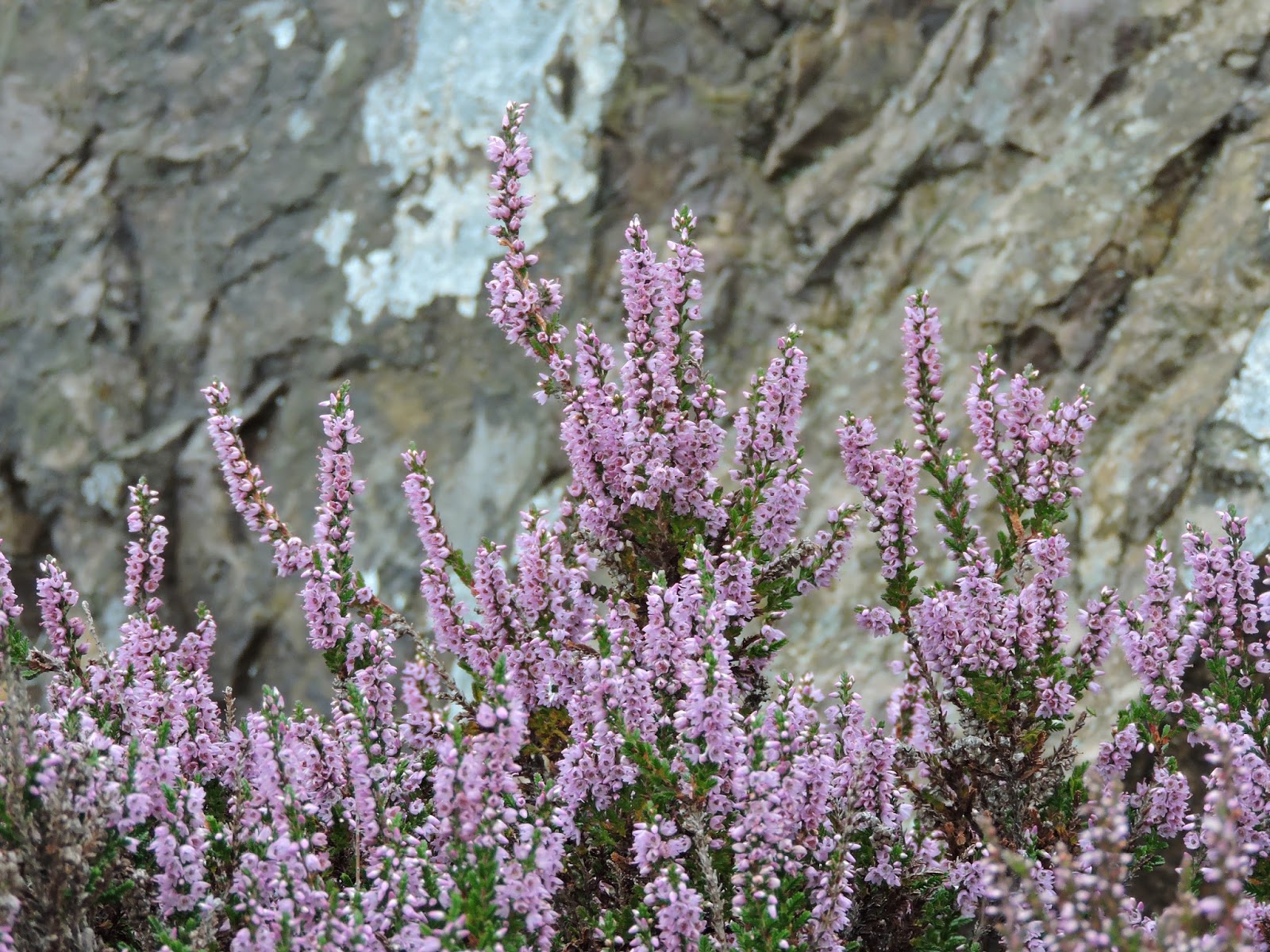
On the northwest coast, there is a lot of heather. Purple fields of heather stretched out for miles on mountain slopes through the bogs. On the east coast, there is a small amount of heather but gorse is far more common. Yellow dots the mountain sides instead of purple.

Pretty purple heather.
Although Ireland used to be a heavily forested area, the English  "tame" it, much is now very bare. There are trees to be seen on both coasts, Most of the trees in the northwest were evergreen trees in small forests at the foot of the mountain. On the east coast, the trees are deciduous. They are huge, with knotted trunks, and many branches. There are also tropical type trees on the east coast, which you do not see on the northwest coast.


What we noticed between the different towns was definitely their size. Some towns like Greystones branched every which way, before turning into homes and churches. Other towns like Westport you could walk through its one street in just a few minutes. What remained constant throughout Ireland was the kindness of the people. Everywhere we went we were warmly welcomed. Especially in the smaller towns, where we had heart to heart talks with some of the staff. Regardless of where we stayed, there was always amazing food waiting for us at the end of a long and tiring hike.

Greystones may be home for us, but it was a magical experience to visit the western coast. It is amazing how much the landscape, plants, weather, and towns changed 5-6 hours to the northwest.

Saturday, September 17, 2016

Guest Blog: Achill Island


This is our academic blog post on the abandoned village on Achill Island. This blog contains the adventures of Brad, Meghann, Elizabeth, and Eva.


 ~~~~~~~~~~~~~~~~~~~~~~~~~~~~~~~~~~~~~~~~~~~~~~~~~~~~~~~~~~~~~~~~~~~~~~~~

We visited Achill Island, on the west coast of Ireland where the land is 87% peat bog.  Becuase of the poor soil farming enough food to live on was quite difficult. When the British invaded, the Irish were pushed to the western edge of the country where the ground was rocky, boggy and sandy. They were slowly starving to death when the potato plant was introduced. If it wasn’t for the potato plant they would have starved. The potato can grow in harsh soil and is very nutritious. Between 1845­ and 1852, Ireland the potato crop failed, bringing a Great Hunger on the Irish people and millions of people starved to death, died from famine-related diseases, or emigrated elsewhere. 


Life during the Great Hunger was not easy. We must stress the point that this time period was not a famine, due to the fact that there was plenty of food in the country. Great Britain was exporting most of Ireland's supplies, leaving the people weak and starving.  For clothes, the women would go out along the wire fences and collect the tufts of sheep wool stuck to them. They would string it together into yarn and make hats, shirts, and gloves, anything to keep them warm.

Sheep still dot the landscape


In such a harsh environment, it was easier for the people to live in community with each other and help each other than it was to live alone, miles from anyone else. The typical house was very small and simple. Four stone walls and a thatched roof. There was often a stone wall to keep animals out of the area where the family would have potato beds and a garden. In some of the stone buildings, there was a large rectangular “window” that seems to have been shelves. The houses were the size of a normal college dorm room. Now imagine, instead of having 2-3 students in there that there were families of twelve or more. The space just got a lot smaller. That is how these families lived. They were in deep poverty and living off of an unforgiving land. They built their homes from the rocks in the boggy soil. Since there were no trees, the fuel for their fires they had to cut, dry, and haul peat sod from the bogs themselves. This is a practice that many on Western Ireland continue to this day. Their lives were hard and it only got worse when the Great Hunger came.

The corners of the building were very well made.

There were these half "windows" in many buildings. Perhaps they were shelves?

Very small space.

The English, in an embarrassed attempt to “save” the people, decided that, instead of giving them their food, they would send the Irish away. They began offering tickets to Irish families for a ship that would take them to America. It was a difficult choice for the Irish. They love their land. But they and their children were starving. Some families were forced to accept the ticket. This is why there is such a large Irish-American population. Once overseas the people would try to bring the rest of their family over to their new home. Most sent what little money they made back home so that they could buy a ticket or at least survive. This was such a hard time for the people of Ireland that the people who lived through it would not speak of it and many of its stories were lost.
 

No one knows what happened to the people in this village. Maybe they died from starvation. Maybe they moved to try to make a better life for themselves. Maybe this village decided to take the ship to America.

The waves in the earth that were once potato beds.

To this day the life these people lived can still be seen.To grow potatoes they mixed their own soil in "beds" and these rolls of earth can still be seen beside the small houses. Although there is still much  controversy over the Great Hunger between the British government and the Irish people, it  does not rule out the effects that it had on the country as a whole. The death toll was  particularly high and hardship found in each home was tragic. The points made in this blog are from an Irish perspective, but people can argue who started the atrocity or why it came about, but it is in the past and now it is important to look at the effects and what it left behind, a stronger Ireland.  

We are not going to go as far to say this area felt haunted, but the thick mist lying over the hill did not help. This walk, however, was very humbling. To see the size of these homes and know how many people lived in them was very sad. The entire home was only about the size of a regular college dorm that we would complain about sharing with one or two other people, but these homes were usually shared with two families that could house up to 20 people. Seeing these homes gave us a feeling of thankfulness for the blessings we have in our homes and the food we have at our disposal and not fearing a famine, or hunger, such as this.

A thick mist covered the hill.

Friday, September 16, 2016

Differences in Ireland


Although travelers to Ireland don't have to deal too much with a language barrier, there are a lot of differences in the Irish Culture. I've hardly grazed the tip of the iceberg so this post is really only an introduction.

I know some of you have been wondering how the size of Ireland compares with the United States. Ireland is tiny. Sometimes, I think it is hard for the locals to grasp at how huge the States are. The combination of Northern Ireland (UK) and the Republic of Ireland equals about the size of Indiana. Their population is very close too. With the combined Ireland being about 5.5 million and Indiana being about 6.6 million. Putting that a little more in perspective, it took us 5 hours to drive to the northwest coast of Ireland in Donegal from the eastern coast at Greystones. So it is a lot smaller here, but that makes traveling far easier.

Of course, the accents are different here as are some of the words. Here are a few. With the US term being listed first followed by the Irish equivalent.

Rock = Stone
Line = Que
Bathroom/Restroom = Toilet
(when I was waiting in "line" for the "restroom" a little Irish girl came up beside me and asked in her beautiful accent, "Is there a que for the Toilet?")
Pants = Trousers
(This is possibly the most humorous one. Pants in the US mean jeans or sweats or something of the sort. Here "pants" is the term for underwear. So if you're shopping and call out to your friends "I really like these pants!" then the locals get rather weirded out.)
Sweater = Jumper
Candy = Sweets
Eraser = Rubber
Check (for your meal) = Bill
Elevator = Lift
Cookies = biscuit
Gummies = Jellies
Parking lot = Car park
Sidewalk = footpath

And those are just some of the differences in the words that are commonly used.

Some more random things I've noticed:

  • Taxes are included in all the prices.
  • Tipping is not really a thing here. The only time it is appropriate to tip is at a nice restaurant with very good service, and even then 10% is considered a very nice tip. 
  • Their grocery stores don't carry much medicines and first aid stuff, that is found in a separate pharmacy. 
  • Since the US is a superpower and whatever happens there affects everyone, including this lovely isle, most of the Irish know more about American politics and the Presidential candidates than most Americans and they are always eager to talk about politics.
  • The Irish are also a very soft spoken people. They talk low, and often quite fast. This combined with their accent can be hard to understand at times.
  • Not only is the electricity current different with differently shaped outlets so that we have to use adapters but in order to use the outlets you have to flip a little switch to turn it on.
  • The light switches are always located on the outside of the room so in the first few weeks here I walked into a lot of dark rooms then had to go back out then turn on the light.

Of course, this is just dusting the surface, but that is all I can think of at the moment.
If you have any more questions about the differences between the US and Ireland, comment below and I'll do my best to answer. No promises that I'll be able to though.

Thursday, September 15, 2016

Guest Blog: Donegal Castle


This is our academic blog post on Donegal Castle. This blog contains the adventures of Brad, Meghann, Elizabeth, and Eva.

Meghann and Elizabeth had fun exploring the castle after the tour was done and snapped a few pictures for fun.

~~~~~~~~~~~~~~~~~~~~~~~~~~~~~~~~~~~~~~~~~~~~~~~~~~~~~~~~~~~~~~~~~~~~~~~~

Medieval Ireland was a dark and bloody place. The Irish built fortresses of defense against their enemies. Unlike the castles in England which were seats of power and villages, Irish castles consisted mainly of a utilitarian tower and wall to retreat to in times of strife.
The lower levels of the Donegal Castle
Steep, spiral stairs

A model of the original castle
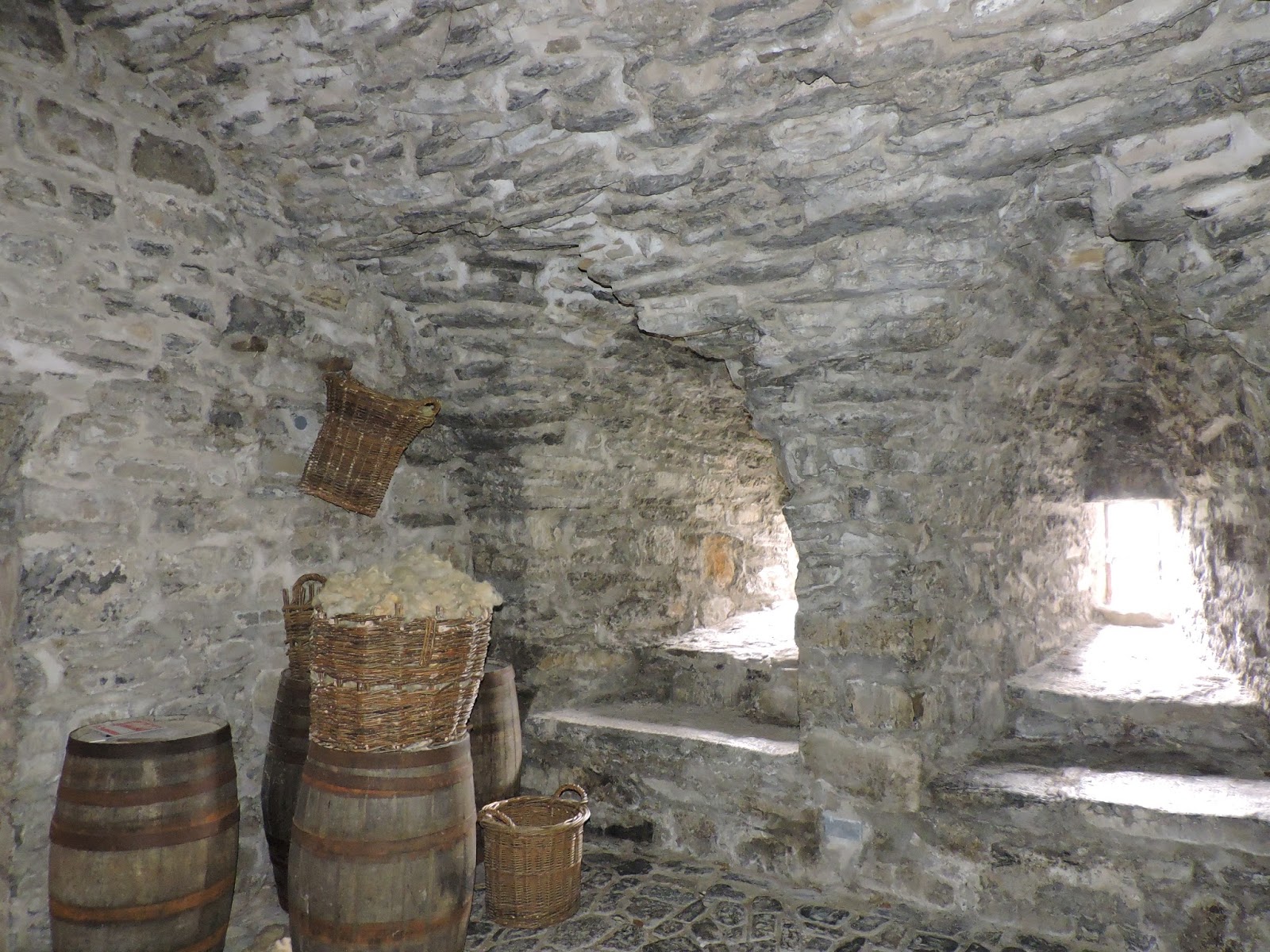
Donegal castle, like most of Ireland's other castles, was built to last. The walls are three meters thick to resist the thunder of battering rams and catapults. The castle has a barrel vaulted ceiling. It was built by placing rocks on a wooden triangular support and packing the cracks between the rocks with mortar. The mortar was made out of horse hair, animal blood, egg yolk, sand, and crushed shells. The lower level is very dark since the only windows are narrow slits for the archers to shoot out of. On the interior, the wall around these windows angled back to give the defenders an advantage. This is called an embrasure. The opening itself was covered with stretched pig intestines since there was no glass at that time. The stairs to get to the upper levels of the tower are tight spiral stairs turning in a clockwise direction. Since most swordsmen are right handed, this gives the defenders an advantage. The defenders are free to strike from above, but the attacker has the hassle of his sword arm being trapped against the wall. The stone of the steps are purposefully arranged to have varying heights and widths to distract and trip any attackers.

Barrel Vaulted Ceiling


Life at that time was hard and focused strictly on survival. The people had little comforts. The lower level of the tower were the storehouses and kitchens where only servants entered. Only the chieftains had boots to protect their feet from the hard slap of bare feet against cold cobblestones. So the servants spread straw on the floor to protect their bare feet.
Model of the castle after the English added onto it.

What the Castle looks like now.

The ruins of the building that the English added onto the castle.

The castle was built in 1474 for the purpose of defense. This is still noticeable on the lower level which is the original structure. The O’Donnell family is the Irish chieftain family which originally built Donegal Castle.When they led a rebellion against the British, they were defeated and the castle was taken by the Brooke family. The Brooke family then added a second level to the castle and a whole new building. The first level is much darker with sloped entrances, symbolizing its defensive structure. The second level, on the other hand, is much brighter with decorative carvings and wood floors. This was where the family dined. The third level was their living quarters.


The fireplace for the women.

Dinner table and fireplace.

When first built, there were very few windows because it wasn't safe to have large openings that enemies could shoot you through, but once English gained control, they added lots of large windows. From the outside, you can see many tall points that make it look like a castle we imagine in our heads. However, when first built it was much flatter and those points were added later by the English. The castle has fireplaces for heat during that time, but more were added by the English. In the large dining hall in the upper castle, there were two large fireplaces. One fireplace was for men to dine and talk about the politics of the day while their wives could sit by the other and sew.


Donegal Castle holds a lot of history and unique characteristics that reflect the time of both families during their reign. For the most part, the castle still looks like it first did when the families lived there.  It was also interesting to consider the differences between castles in Ireland and  those in England. The castles in England and Scotland had enormous structures and walls. In Ireland, while great, the castles are far smaller. Our guide explained that since the kings in Ireland were fighting each other constantly, they built strong towers to protect their property. Irish Castles were made to protect property while the castles in England and Scotland, although they were powerful fortresses, they were made to hold entire communities.

Tuesday, September 13, 2016

Guest Blog: Derry Murals


This is the second of our academic blog posts, taking place in Derry in Northern Ireland. This blog contains the adventures of Brad, Meghann, Elizabeth, and Eva.


Note from Elizabeth: Although I covered some of Derry, this blog gives a deeper look at more of the murals.
~~~~~~~~~~~~~~~~~~~~~~~~~~~~~~~~~~~~~~~~~~~~~~~~~~~~~~~~~~~~~~~~~~~~~~~~~~~~~


We made a trip to Derry, which is located in Northern Ireland and is the site of Bloody Sunday. Derry holds a lot of history regarding "The Troubles" in Ireland.  When the English came over to Northern Ireland to try to force the English culture in the Irish, they developed a plantation in Derry, the second largest city in Northern Ireland, blossoming it into  a mini version of London. That is why the signposts and legal documents record the city  by the proper "English" name, Londonderry. However, many people would not stand for this and continued  to call it Derry. This caused much bloodshed in quarrels over who should rule the city -- the English or the Irish. For decades they fought and many battles took place, such as the Battle of the Bogside, in the very streets that we walked.

The Civil Rights movement in America spread and on January 30, 1972, a Civil Rights march took place. This Sunday in Irish history became known as Bloody Sunday because the unionists fired at the 26 civilians participating in the peaceful civil  rights protest against internment. The  government stated that the unionists were firing at men who were armed with guns or bombs. 

After peace came in 1998, Three artists were chosen to paint the story of the Troubles in Derry. Two of the artists were Catholic and one was Protestant. These Murals were painted on houses along the street in Bogside Derry where the fighting took place. We'll only cover a few that have a particularly interesting story.


Some murals have more back story than others. This one that depicts three young boys running is actually about three specific young men who died during the tensions. One of the boys was shot by a sniper of the enemy army. Another of the boys was killed when an unstable bomb he was transporting exploded in his arms. The last boy was killed by stepping on a land mine that was set by his own side, the IRA. Each of these boys died in terrible ways that only occur during a time of war such as this. The hardest thing about a mural like this is how it depicts such young boys. It is easier to think of men going out and dying in war but the reality is that boys, who are in their teenage years, lost their lives.


Out of all the murals, there were a few that stood out and really touched us. One of these was a mural with a fourteen year old girl, a butterfly, a pile of rubble, and a rifle. The girl was sent out into the school yard by her teacher to grab some stones for a project they were doing. The British soldiers at that time were packing up their gear and leaving Ireland for good. The war had finally come to an end. As they were driving past the school, a soldier decided to kill one last Irish. He shot her in the head. She was killed instantly. The mural originally depicted the girl with the butterfly in grays and the rifle next to her. Four years ago the mural was repainted, now the butterfly is rainbow-colored to symbolize peace and hope. The rifle next to her was repainted so that the rifle was broken symbolizing that the war was over. That Ireland won against the British. It is awful to think that someone killed a little girl just for the fun of it.


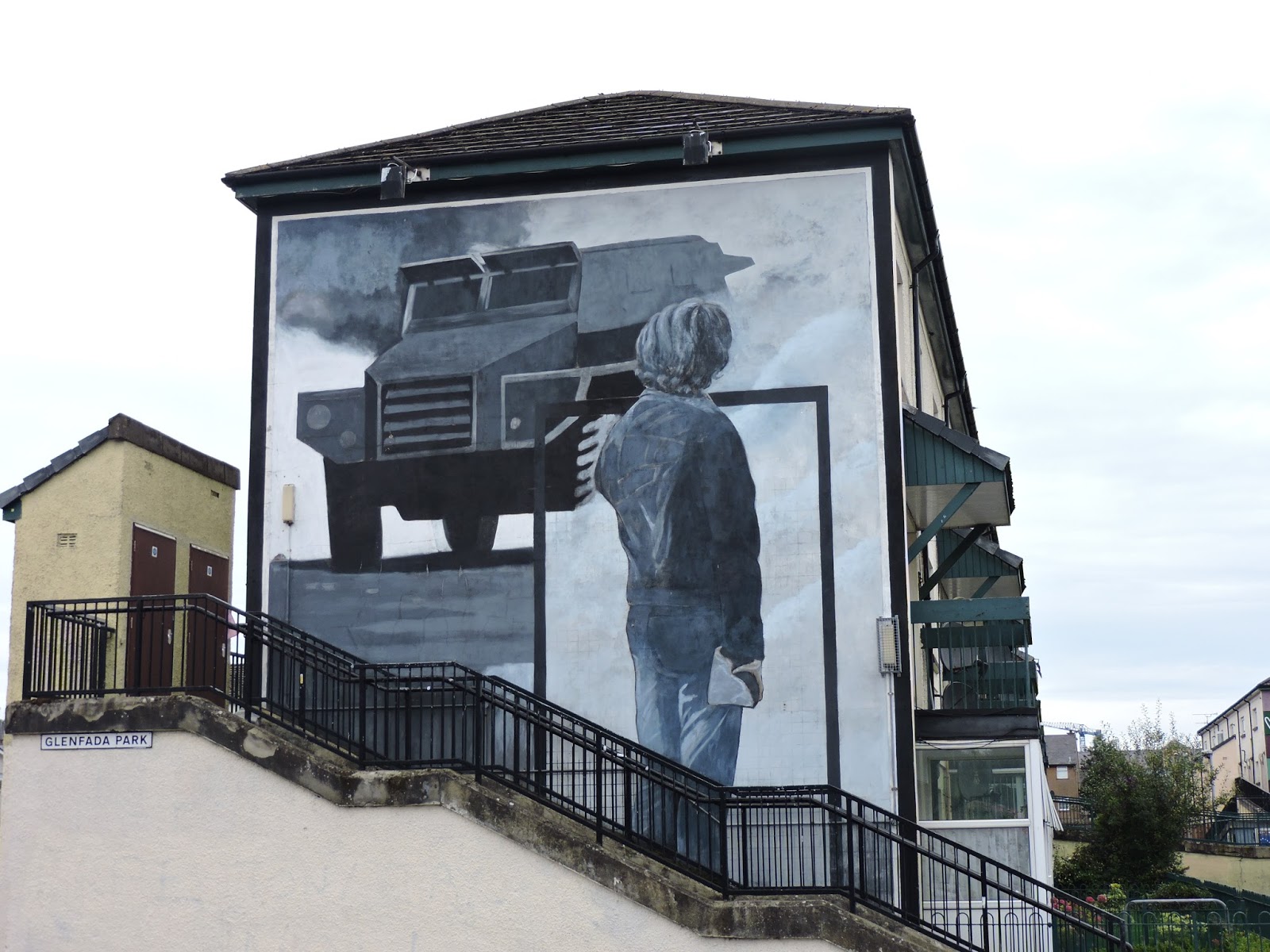
Like the previous murals, many of them told a story. It is no different for this one. This Mural depicts a young man standing in the middle of the road which acted as the battlefield. The battles would come in predictable heats. Gunfire would fill the streets and dust rose from the scuffle then when it was time for dinner both sides would retreat and return later. Not so for this young man. He stood there all the time. He would wait for the others to return and would be the first to fire at the enemy. Only his ammo was not bullets, but bricks, rocks, and other rubble scattered over the streets. His shield was a bed spring. Eventually, he was killed when he was run over by the enemy in their trucks.

The final mural, which was also the last one to be painted was not created until after the peace treaty was finally signed in 1998. The artists asked the schoolchildren what they thought should be painted and this is what they decided on. The background starts as drab gray and browns at the bottom and brightens into cheerful colors at the top. This represents the city coming out of darkness into the light. Out of warfare into peace. The outline of the dove is also a representation of peace. It is combined with the silhouette of an oak leaf representing the city of Derry. The proper pronunciation of Derry is Dira which means oak. It was named this because the place where Derry was founded was once an island on the River Foyle with a grove of oak trees.
The Peace Bridge across the River Foyle in Derry
Although after peace was proclaimed, bloodshed stopped, and a Peace Bridge was built across the “divide” between the two cities, there is still a heaviness in the air. As we walked through the streets, we could still feel some tension between the two communities. The hurts that they faced were still too near to be completely healed. There is peace, but it feels like the story isn't over yet.