Saturday, September 10, 2016

I Climbed Croagh Patrick

I climbed Croagh Patrick ... and I had to get a shirt to prove it.

As we watched the mountain loom closer and closer for the last 20 minutes of the drive toward Westport. It didn't look as hard as it felt on the way back down.

 Croagh Patrick is the legendary mountain St. Patrick is said to have climbed barefoot and where he fasted for 40 days and 40 nights. Every year there is a national pilgrimage that thousands attend and climb Croagh Patrick. Some Catholics performing penance, do this hike barefoot to this day.

The trouble started almost as soon as we climbed out of the coach. I forgot to fill up my water bottle at the hotel, and promptly discovered that the water was unsuitable to drink. Fortunately, Mrs. Cosgrove was sweet and gave me some of her water. 

At the base of the mountain was a very nice riding stable. It was tempting to go hang out with the ponies instead. It was even more appealing when we got to the top.

Then the hike started. It was a sloped asphalt path to get the the base of the trail.

Then the footing changed completely.
We have to climb WHAT!!!!!
Another view of the footing.
Shouldn't this path be going toward the mountain and not away?
 This would be torture to walk barefoot. We saw a few people that day who were barefoot and we saw blood on the rocks proving the folly of it.

After the initial surprise, I took on the mentality of a mountain goat and climbed steadily, unfortunately energy only game in spurts, but the views were spectacular and stopping to take pictures was as good as any to take a break from the steep climb over piles of rock.

I loved this curly island in Clew Bay behind us


During the lower parts of the hike, this lovely creek cheerfully tumbled beside the trail and gave an mystical feeling and a sight that seems to come from a fairytale's enchanted isle. Don't you agree?


That is our road. The white line cutting through the mountain.

In fact, I loved every aspect of Clew Bay.
I've shown several pictures of Clew Bay. It was a stunning bay with a fantastic history. In years past a Irish Pirate Queen roamed these waters in her shallow bottom boat, running other pirates ashore on unseen sand bars.

My companions up the mountain changed the higher we went since most of the group were ahead of me. By Paige and I decided that we had to at least see the other side of this dreadful mountain.

Step by step we came closer. Finally, we reached the halfway point, which was also where I ran out of water.
The far side of the mountain.

More mountains behind the mountain we stood on.

Looking back. See how far we've come? Remember this was only the easier half.

This was where Paige turned back, but I decided to continue on. (This is arguably one of the worst decisions I have ever made.) The path continued to the right. At first the going was fabulous. It was the easiest part of the hike, reasonably flat, few rocks, mostly packed dirt and pebbles. That was the path across the ridge of the mountain.

Then I reached the foot of Croagh Patrick. And with every yard uphill, the experience went downhill.
The footing turned from bad to terrible. How would someone even do this barefoot?
WHATTTTTTT!!!!!!!!!!!!!!!!!!

WHAT IS THIS!!!!!!!!!!!!!!
It just got worse. It got steeper and steeper and the last 30 minutes of the hike had to be done crouched over using your hands and toes to climb almost strait up on sharp rocks like this.

This is the best representation of how steep this hike was, and it does not do it justice. It only got worse from here.
The only good part about climbing this is that the views continued to improve.
When I finally met up with the rest of the group heading back down, I was out of breath, exhausted and 100% ready to give up. I'd been out of water for awhile and was parched. The group encouraged me, Carlee gave me her water and they told me that I was "only" fifteen minutes from the top. Sweet Emily climbed the rest of the way up, again, with me.

The Church at the top. In which mass is held during the annual pilgrimage.

I made it!
The weather had been fantastic and the mountain top perfectly clear for the several hours while we were hiking. However, the clouds decided to descend on the mountain just in time for me to reach the top and I could hardly see any of the "great" views I'd worked so hard to see. The clouds parted just enough so I could see the bay and the evergreen forest, but it was little better than what I'd already seen.
The rest of the group were waiting on us so we had to catch our breath before we started the decent back down, which was almost as bad as going up. It was difficult to know where it was safe to walk. The going was very slow because the footing was so unstable and steep. We practically slid down in places.

But we finally made it back down without causalities. Everyone else was already on the coach and we stepped on and everyone erupted in cheers.

As this whole trip to the northwest was one no Taylor group has done, Diana and Koert were taken aback by the sheer difficulty of the hike. So they talked to Vance, who informed us that we were never supposed to the entire hike all the way up the mountain.


Oh well. It was an interesting experience that I'll never forget and now I have a new T-shirt. 

Wednesday, September 7, 2016

Guest Blog: The Book of Kells and the Trinity Long Room

Exciting news! My blog group posted our first of a series of academic blog posts on our blog Historical Adventurers. It is the long awaited post on the Book of Kells and the Trinity Long Room. Click here to meet my Blogging partners: Brad, Meghann, and Eva, and be sure to give them a round of applause for being such a fabulous group to work with and letting me post this here.

~~~~~~~~~~~~~~~~~~~~~~~~~~~~~~~~~~~~~~~~~~~~~~~~~~~~~~~~~~~~~~~~~~~~~~~~~~~


This is the first of our academic blog posts. This blog contains the adventures of Brad, Meghann, Elizabeth, and Eva.

 (Note: This post has very few pictures because we were not allowed to photograph the Book of Kells exhibit.)


The Book of Kells is a heavily decorated copy of the four gospels of the New Testament. Between the pages of gorgeous artwork, the four gospels are written in Latin, the scholarly language of that time. There is no exact date of when the book was written, but it is thought to date back to the early 9th century. The book is now at home in the Trinity College library where it was sent around 1654 for safe keeping. The Book of Kells is a very large, inconvenient, book that contains textual errors, which implies that the book was never intended to be read for its content, but rather acted as an altar decoration.


The Book of Kells was purely for decoration rather than practical use, therefore, during the same period as the Book of Kells, missionaries carried smaller utilitarian "pocket" gospels, the Book of Mulling is an example of this, that could easily be slipped into their satchel for travel.


The Book of Kells was completed in 384AD. It is interesting to examine how  this book was made and was able to last so long. Within the Book of Kells is a myriad of pigments including indigo, orpiment (yellow) , red lead, copper green and many others. These colors were  extracted from natural sources and mixed with other pigments to create new ones. These pigments and inks were painted onto pages of calfskin, commonly called vellum. Although expensive, vellum parchment was used for the Book of Kells because it gives the pages a solid, uniform white background. It is estimated that over 180 calfskins were used to create the Book of Kells.


Large folios were folded to create bifolios, something that would  look like a giant birthday card today. These bifolios were sewn together in sets of quires.  This form of construction allowed for measurements to be easily recognized in the quires.  The expected amount of folios for each quire is about four to twelve folios. When observed closely, the guidelines on the page, which were used to create bifolios, can still be seen. Although the  thickness of the folios varies, the vellum is of high quality, which is perhaps why the book has  withstood the test of time since it was first created. 


The penmanship of four different people can be identified in the Book of Kells. These mysterious scribes go unnamed, but the unique style of each gives its ideas as to the character of each. The Book of Kells was written in a formal style known as “insular majuscule.”


Scribe A who copied the Gospel of John, was very conservative and left the decorating of the parchment to another scribe. His manner was very strict and to the point of finishing the piece and soon as possible. Scribe B obviously enjoyed adding flourishes to his letters and had a habit of using colored ink rather than the standard black or brown. Scribes C and D copied Matthew, Mark, and Luke. 


The scribes would decorate the some of the pages to draw attention to a certain passage that they though particularly important. They often left the heavy embellishments to the goldsmith. Despite the differences in these four scribes, it is amazing to see how all their hard work was put together to create such a marvelous book that can still be seen today.


 The beauty of the Book of Kells was overwhelming. The amount of detail on every page showed the love of the Scripture. We all were overwhelmed with the amount of history captured in one room. How such a precious document could remain so pristine for so long. It showed the dedication and love of Christ exhibited by the monks. Their lifestyles, work, schedule, and lives all revolved around the word of God. It was an honor to be able to behold its beauty that they had worked so hard on. 


As beautiful and fascinating the Book of Kells was, we all agree that the long hall was even more spectacular. It was the most beautiful library any of us had ever seen, even though it is ranked second in the world. The smell of old paper fills your nose as you watch someone restore a book, returning it to its original glory. Since we could not take pictures in the Book of Kells exhibit, We've included some photos of the stunning long room, courtesy of Brad. 


~~~~~~~~~~~~~~~~~~~~~~~~~~~~~~~~~~~~~~~~~~~~~~~~~~~~~~~~~~~~~~~~~~~~~~~~~~~~
Note from Elizabeth: My personal, promised story behind this trip to Trinity.
Before we went into the exhibition, we were told to take as much time as we wanted. It just had to be more than a half hour. I was in there taking notes on the Book of Kells for this blog, then I took notes on a section about ancient Irish writing and monastic life. Then I studied the fascinating way that this book was made and the symbolism and art that fills the pages of the Book of Kells. Then I read some poetry written by monks. At that point, I realized that no one else from my group  had been around for a long time so I forced myself to move on and view the Book of Kells itself. That takes a detailed study and I took some more notes. Finally, I climbed the stairs to the Long Room of the Library. The smell of aged books and unread stories filled my lungs. I was snapping a few pictures and soaking it in when Diana found me. It turns out that the last group for students to come out had been out for over half and hour and ALL the rest of the group were at dinner. So, Diana and I had to run across town and meet up with them, eat, and go to Riverdance. 
Riverdance itself caused some problems. We got there at least 15-30 minutes in advance, handed out the tickets and promptly realized that the tickets were for the wrong day. Diana was trying to figure their mess up out and they were getting ready to close the doors. We waited anxiously for a few minutes then right before they shut the doors we got our corrected tickets and ran in and got seated minutes before the event started.  
So... That is my side of the story. 

Friday, September 2, 2016

Derry

 The reason why I'm leaving so many stories untold is because we have blog posts to do as part of our schoolwork. Our trip to Derry and Donegal Castle last Saturday is no different. I'll give a few pictures, but the bigger story on the Murals will have to wait until my group puts it together.

On our way to Derry, Brian ( Our super fabulous bus driver, who is the best bus driver in all Ireland)  made an impromptu stop at an ancient round fort. It was said to be made during the time of Christ. We climbed and climbed and climbed the hill to reach it. The bus was sputtering and complaining but we made it. The view was stunning.


Stairs led to different levels within the fort.
The view!

Gateway to the outer world.


We crossed the "border" into Northern Ireland and finally reached Derry where Brian explained the meaning of the murals. A brief history on Derry. When people think of the troubles in Northern Ireland they normally think of Belfast in the East, but Derry was also in turmoil in the west. Derry is split by the River Foyle. The "rich" side on the east of the Foyle is called the waterside and is where mostly Protestant Unionists (those loyal to the Union) lived. It contains the good farming land. The Bogside is where the oppressed Catholic Irish who want Ireland to be its own nation (Nationalists) were sent to.

The trouble came in because the Unionists wanted Ireland to be part of the Europian union while the Nationalists wanted to be free from England. So gunfire and bloodshed resulted.

The picture below represents how the Nationalists felt. The bird is a lark. If you cage a lark it stops singing. If you deprive it of food it weakens. If you beat it, it dies. This is how the Irish felt.
 The Troubles continued. The Civil Rights movement in the US continued on into Ireland. The Nationalists organized Civil Rights marches even though the Unionists forbid them. During one of these peace marches 1972, the protesters were needlessly fired upon and thirteen innocent men were killed. Most of them were quite young. Another succumbed to his wounds and died later. For a time, the myth circulated that the Nationalists had fired first. It took years before they admitted that that accusation was completely unfounded and these fourteen people were completely innocent. This tragedy became known as Bloody Sunday.

The faces of those killed.

 I'm going to try to give a brief overview of the Murals. More detail will be given in our group blog. (This is already far too long.) These Murals were painted on houses along the street in Bogside Derry where the fighting took place. I'll only cover the ones have a particularly interesting story and/or that won't be in our group blog post.

This Mural depicts a young man standing in the middle of the road which acted as the battlefield. The battles would come in predictable heats. Gunfire would fill the streets and dust rose from the scuffle then when it was time for dinner both sides would retreat and return later. Not so for this young man. He stood there all the time. He would wait for the others to return and would be the first to fire at the enemy. Only his ammo was not bullets, but bricks, rocks, and other rubble scattered over the streets. His shield was a bed spring. Eventually, he was killed when he was run over by the enemy in their trucks.

 The Mural below was blocked by scaffolding because it was being repaired. Although it is hard to see it depicts a young 14yo girl who was in school. Her teacher sent her to gather stones for her geology class. While she was in the streets picking up pebbles, a sniper on the wall shot and killed her. The background is dark and represents the chaos and rubble that the streets were reduced to.  The butterfly was originally painted gray until 1998 when it was colored to represent the new peace. There is also a gun in the picture. It was whole during the Troubles, but when peace came it was repainted to be broken.


 I wasn't given much story behind this Mural, but I believe it speaks for itself. As heart pulling as the stories behind the other Murals were, this one is tragic just by looking at it. It is depicting the tragedy of Bloody Sunday. Brian said that it was this Mural that held the most impact on him and many other young Irish boys.

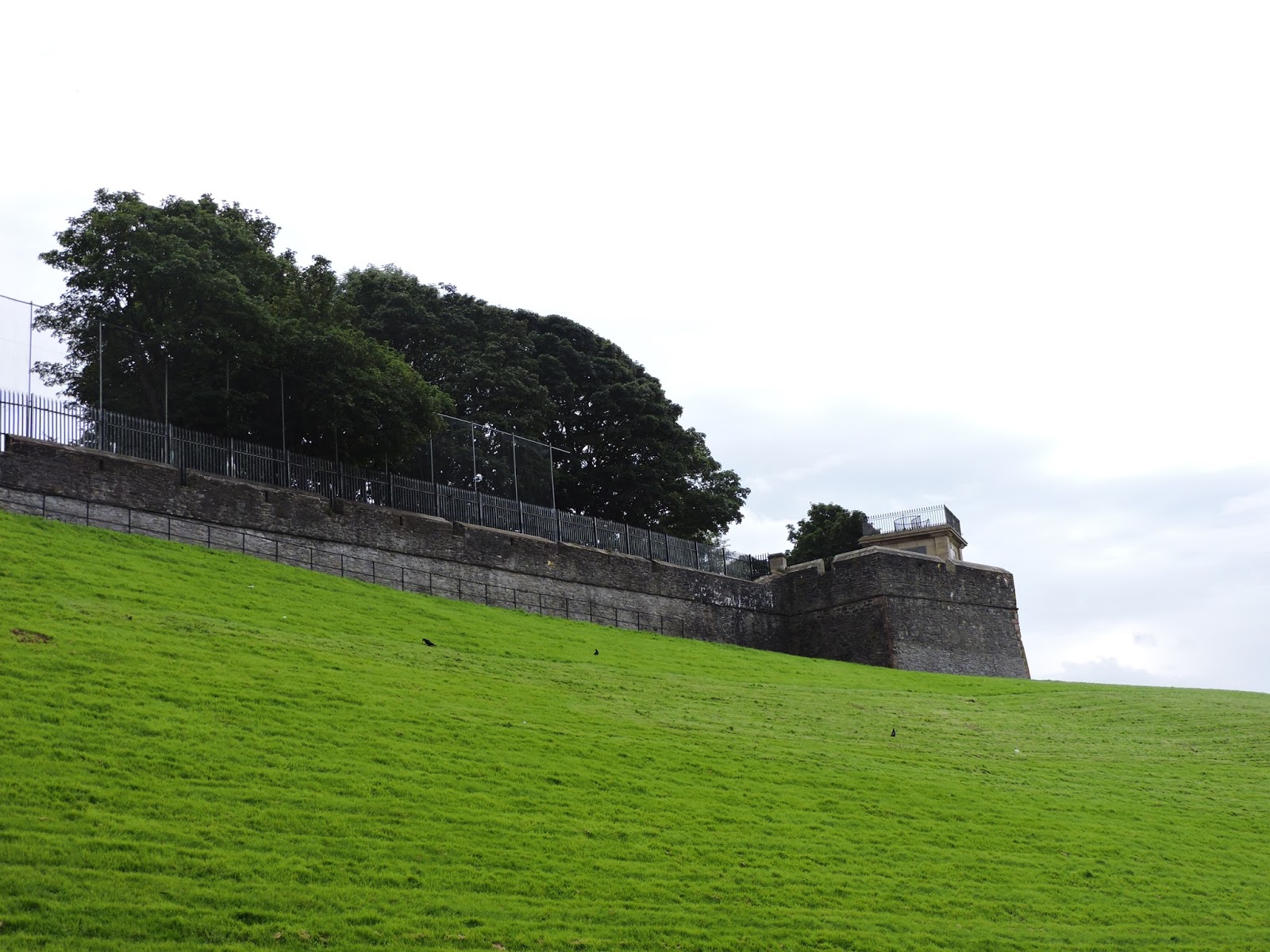
On a slightly brighter note: the rest of Derry. Derry is one of the only walled cities remaining. It was neat getting to walk on them. Despite the age of these walls and the battles they have seen. The walls of Derry have never been breached. In the 1600s (I believe) the Irish were rebelling against the English in Derry. They held Derry in a lockdown siege. 20,000 English lived in Derry but they were reduced to 8,000 because of starvation. If the Irish would have known how weak the English were, History would have dramaticly changed.
 Funny story. I was snapping pictures when suddenly the rest of the group in front of me started screaming and ducking. I heard a whirring overhead. Instinctively, I ducked down. Just in time because a flock of pigeons flew just inches above our heads. We could feel the wind from their wings! Crazy birds. 
 This is Derry's medieval tower
 Cannons lined the walls. Brian said one of them has a rose stamp and was from the Tudor period.
 Every gate in the wall was marked from ontop of the wall.
 Notches for archers to shoot arrows though lined the wall. This one looks out into Derry.

Beautiful church.
 In 1998 a Peace Treaty was signed. Immediately this Peace Bridge started to be built. It is a step in the right direction to healing the hurts that mar this city. Although it is decades later, we could still feel tension hanging in the air.
 This lovely city hall has an interesting story. During the Troubles a Unionist (Sorry. I don't remember his name.) bombed this building, destroying it. After peace was made and the city hall rebuilt, he gave a speech in there. When he was finished, everyone gave him a rousing applause. As he sat down he murmured, "Last time I was here I literally brought the house down.)


Sorry for the long post, but this City held so much depth. I haven't which day yet, but next week I'll do a post about my brouhaha on Croagh Patrick -- Ireland's Holy Mountian. That is a story well deserving of its own post...